ONLIM FAQ
Questions and answers about Onlim
About ONLIM
The platform connects company data, web content, documents and existing systems, making information accessible in natural language for customers, employees and partners.
Typical use cases include customer service, sales, HR, internal helpdesks and service-intensive departments. ONLIM is especially suited for companies that need more than a simple DIY chatbot: a reliable AI solution with expert guidance, project support and a dedicated ONLIM contact.
AI Chatbots, Voice Agents & Agentic AI
An AI chatbot helps companies automate recurring inquiries, improve availability and reduce response times. Customers receive fast and consistent answers, while service teams can focus on more complex or sensitive requests.
ONLIM chatbots can support customer service, lead qualification, appointment booking, information requests and internal support processes. The solution is planned, implemented and optimized together with ONLIM’s experts.
ONLIM offers AI chatbots and voice agents for websites, webchat, phone, SIP, messenger channels, email, web interfaces and other digital touchpoints.
Depending on the use case, information and processes can be made available across multiple channels, ensuring consistent communication via chat, voice, email and other contact points.
Agentic AI describes AI systems that do more than provide information. Based on defined rules, data sources and processes, they can also carry out tasks.
Depending on the use case, these systems can collect data, classify requests, trigger processes or pass on information in a structured way. What matters is that automation remains controllable, traceable and properly embedded into existing business processes.
A chatbot primarily communicates through text-based channels, while a voice agent, sometimes also called a voice bot, automates spoken conversations, for example over the phone or through voice-based interfaces.
An AI agent goes one step further: it can not only answer questions, but also trigger actions, process data or initiate workflows in existing systems, depending on the setup. In practice, chatbots, voice agents and AI agents can work together as part of a modern Conversational AI solution.
An ONLIM voice agent can automatically answer calls, understand requests, provide information, collect structured data, classify inquiries and route callers to the right team or process.
Depending on the use case, voice agents can also trigger workflows and integrate with existing business systems. ONLIM supports companies from concept and setup to implementation, testing and ongoing optimization.
For more detailed questions about voice automation, visit the ONLIM Voice FAQ: https://onlim.com/voicebot/#faq
Yes. ONLIM can also support live chat and webchat setups, depending on the project requirements.
In most cases, live chat is considered as part of a broader Conversational AI strategy, together with AI chatbots, voice agents, automation and integrations into existing service processes. This allows companies to combine automated support with human handover where needed.
Technology & Answer Quality
Knowledge Graphs structure information by connecting content, terms, relationships and context in a machine-readable way. This helps AI systems understand how different pieces of knowledge relate to each other.
For Conversational AI, Knowledge Graphs improve the quality, consistency and reliability of chatbot and voice agent responses.
Learn more: https://onlim.com/chatbot/technologie/knowledge-graphen/
ONLIM uses Knowledge Graphs to structure company knowledge and make it usable for AI chatbots, voice agents and digital assistants.
In combination with modern LLM and RAG approaches, Knowledge Graphs support accurate, context-specific and traceable answers. They are an important part of ONLIM’s technology for building reliable Conversational AI solutions.
Learn more: https://onlim.com/chatbot/technologie/knowledge-graphen/
RAG stands for Retrieval Augmented Generation. It means that answers are not generated solely from a general language model, but are enriched with information from connected knowledge sources.
For companies, this is important because answers can be more accurate, up to date and aligned with internal content. The knowledge sources used are defined and approved during the project, ensuring that relevant and verified information flows into the answers.
ONLIM reduces the risk of incorrect or hallucinated answers by using structured knowledge sources, approved content and clearly defined processes.
Instead of generating answers freely, the system retrieves information from verified sources such as internal knowledge bases, documents or connected business systems. Additional rules, guardrails and escalation logic can be defined to ensure that sensitive or unclear inquiries are handled correctly or passed on to employees.
Implementation, Integration & Support
ONLIM helps companies design and implement AI chatbots and voice agents that fit their goals, target groups, channels and processes.
Together with you, ONLIM defines relevant use cases, knowledge sources, integrations and escalation paths. Throughout the project, you have a dedicated ONLIM contact person who supports you from concept to launch and further optimization.
Yes, selected parts of the chatbot can be maintained independently, depending on the project setup. This may include content, knowledge sources or other configurable elements.
However, ONLIM is not a simple DIY chatbot tool. Projects are supported by ONLIM experts to ensure quality, reliability and smooth integration into existing processes.
Yes. ONLIM can be integrated into existing system landscapes via interfaces, for example CRM, helpdesk, ERP, booking or other business systems.
This allows Conversational AI not only to provide information, but also to connect with existing processes, data and workflows.
The effort depends on the scope and desired capabilities of the solution. A clearly defined use case can usually be implemented faster than a more comprehensive project with multiple channels, integrations and complex knowledge sources.
ONLIM guides companies through the project in a structured way — from defining use cases and setting up the solution to implementation and ongoing optimization.
Yes. A good Conversational AI solution should be designed so that requests can be handed over to employees when needed.
Especially for complex, sensitive or unclear inquiries, the combination of automation and human support remains essential for a good user experience.
The cost of an AI chatbot depends on the specific project requirements, including functionality, channels, use cases, integrations, knowledge sources and overall setup.
ONLIM does not offer standard chatbot packages or one-size-fits-all pricing for chatbot projects. Each project is evaluated individually to ensure that the solution, effort and investment match the company’s goals, processes and support needs.
Data Protection & Hosting
Yes. ONLIM is designed for GDPR-compliant use in companies and organisations.
The specific data protection requirements depend on the use case, connected systems and data being processed. These requirements are clarified together during the project. ONLIM solutions are also used in sectors with high data protection and security requirements, such as healthcare and the public sector.
ONLIM is hosted in the EU. This provides an important foundation for projects where European hosting infrastructure, data protection and security play a central role.
Specific hosting and operational requirements are clarified together in each project.

LEARN MORE ABOUT THE TECHNOLOGY BEHIND IT
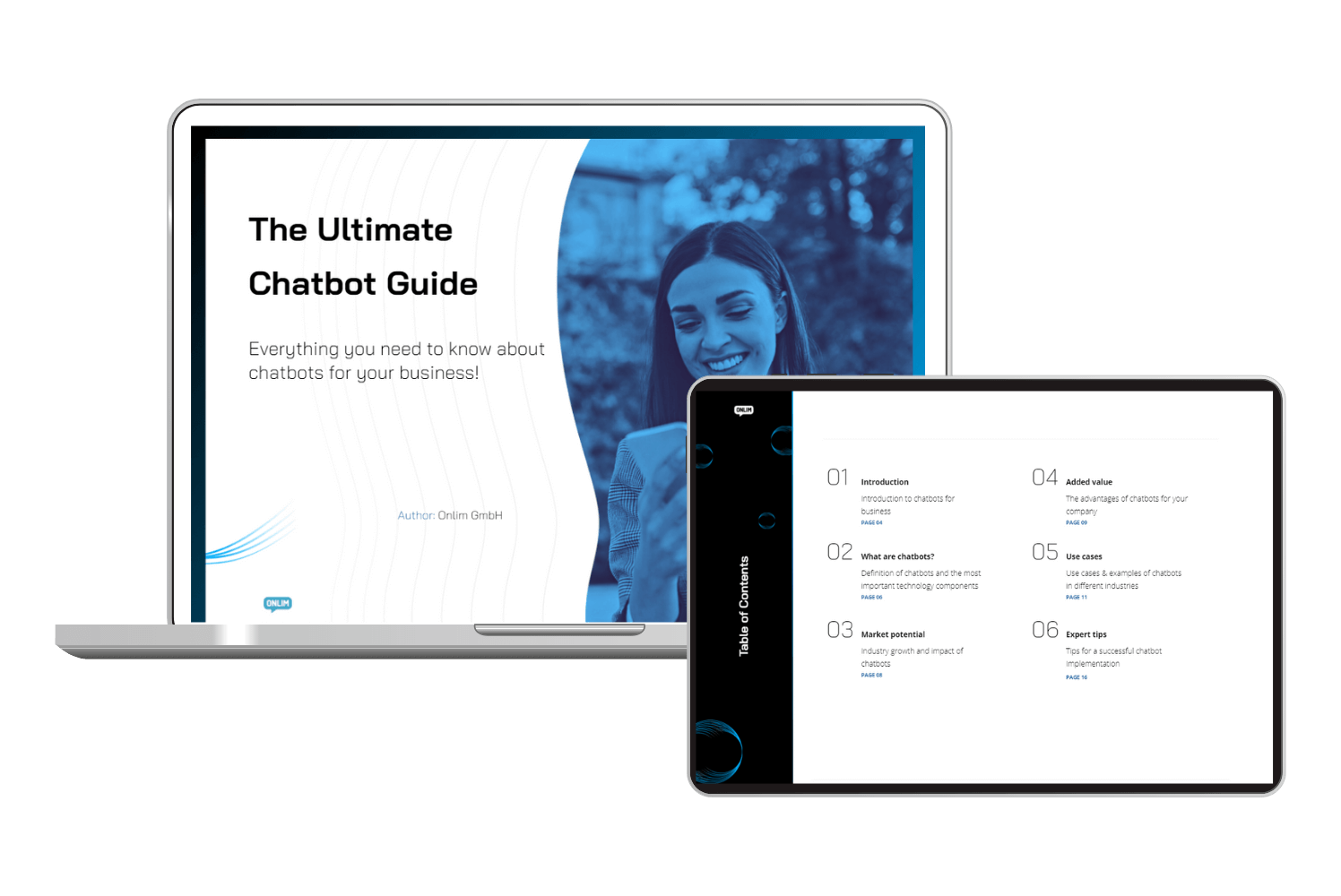
The Ultimative Chatbot Guide
A chatbot is a form of automated service – like a robot that customers can communicate with via chat. Chatbots that are able to learn can understand natural language and therefore do not need as specific commands. That means bots based on Machine Learning get smarter with every interaction.
- Chatbot basics & technology
- Chatbots for your company & implementation tips
- Statistics & trends